
“There’s a fee number on my statement I’ve never seen before. Did something change?”
A question I expect to hear in 2027When your December 31, 2026 statements arrive in January or February 2027, you’ll notice something new: a section that adds up the ongoing costs of your investment funds and shows the total as a dollar amount.
This comes from new Canadian rules called Total Cost Reporting. Seeing a dollar figure for the first time can feel surprising, so I’d like to walk you through it before your statement arrives. No jargon, and no surprises.
The most important thing to know: total cost reporting doesn’t add new or higher fees. You’ve always paid these costs as part of owning these investments, and we’ve talked about them together. What’s new is that your statement will now show them in dollars, in one place, in plain language.
In this article
What is Total Cost Reporting?
Total Cost Reporting is a set of disclosure rules developed together by Canada’s securities and insurance regulators: the Canadian Securities Administrators (CSA), the Canadian Council of Insurance Regulators (CCIR), the Canadian Insurance Services Regulatory Organizations (CISRO), and the Canadian Investment Regulatory Organization (CIRO). The final rules were published in April 2023 and took effect on January 1, 2026.
It builds on an earlier reform. Since 2016 (under rules known as “CRM2”), statements have shown what you paid directly to an advisor’s firm, such as advisory fees and commissions. But the costs inside each fund, like management fees and trading costs, were only shown as a percentage in fund documents. Total Cost Reporting fills that gap. You may hear it called “CRM3.”
In the regulators’ words, the goal of total cost reporting is to help investors understand the costs they pay so they can “assess the value they receive.” I couldn’t agree more.
Which investments are covered by total cost reporting?
- Segregated fund contracts offered by life insurance companies
- Mutual funds
- Exchange-traded funds (ETFs)
- Scholarship plans
Total cost reporting timeline at a glance
| When | What happens |
|---|---|
| April 2023 | Regulators publish the final rules |
| January 1, 2026 | Rules take effect; costs are tracked for the 2026 calendar year |
| December 31, 2026 | The first reporting period ends |
| January to early 2027 | Your first enhanced year-end statements arrive |
What total cost reporting will show on your statement
The exact layout varies from one company to another, but every total cost reporting statement will include:
- A total cost for the year, in dollars. One amount that adds up what you paid to own your funds during 2026.
- A breakdown of that total, usually in two parts. Fund expenses are costs taken from inside the fund, such as management fees, operating costs, trading costs and, for segregated funds, the cost of the insurance guarantees. You never get a bill for these because they’re built into the fund’s daily unit value. Direct or contract fees are taken from your account or contract, such as deferred sales charges, advisory service fees, withdrawal or transfer fees, and, for some segregated fund products, guarantee fees charged separately.
- The fund expense ratio (FER) for each fund you hold, so you can compare funds.
- Plain-language explanations of what the fees are, how they affect your returns, and where to find more detail (the Fund Facts).
- For segregated funds, clearer information about your guarantees, including maturity and death benefit guarantee values, reset dates and, for income products, your guaranteed income details.
Keep in mind that only part of the total goes to your advisor. The rest pays for professional fund management, trading, administration and, for segregated funds, insurance protection.
Total cost reporting terms, explained
MER
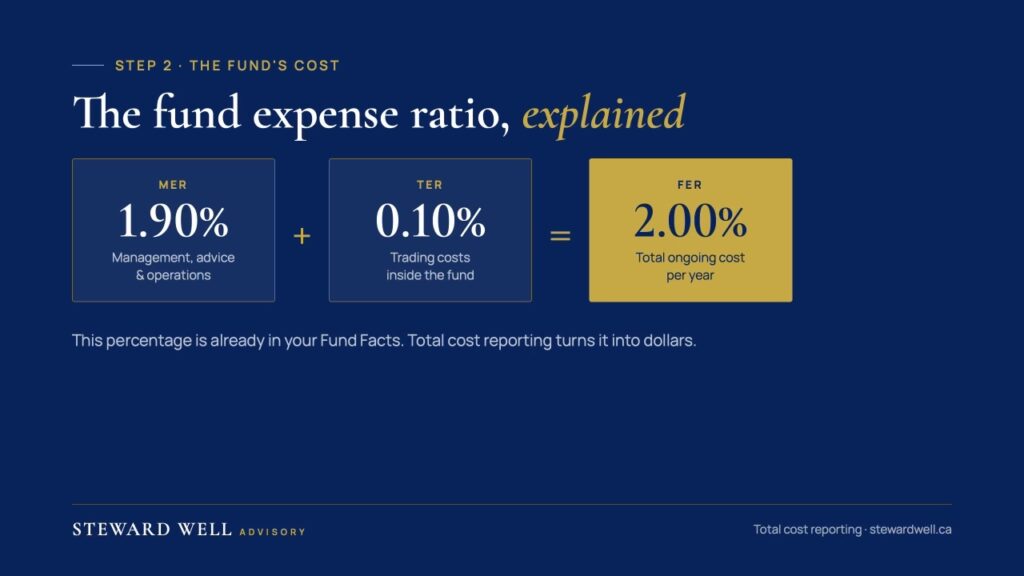
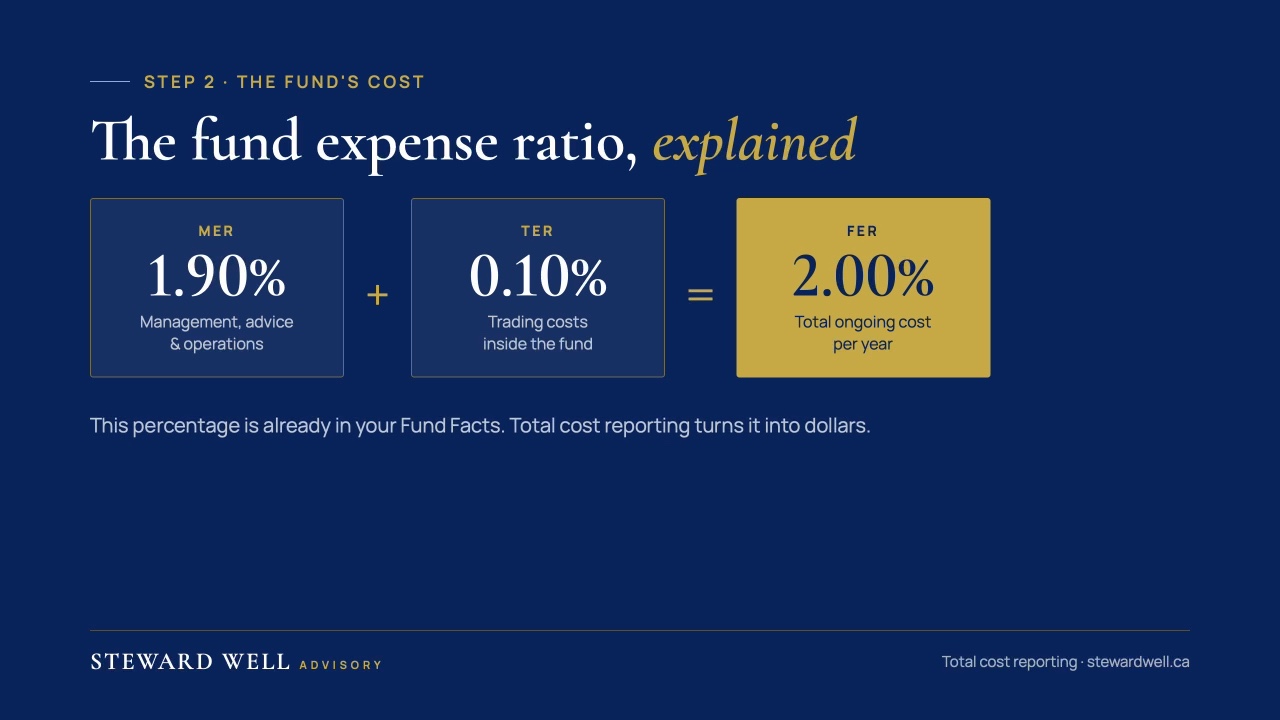
Management expense ratio. The fund’s management and operating costs as a percentage of its assets. It includes professional investment management, advice and ongoing service, fund operations, applicable taxes and, for segregated funds, the insurance guarantees.
TER
Trading expense ratio. What the fund pays in commissions and other costs to buy and sell the investments it holds, as a percentage of its assets.
FER
Fund expense ratio. The MER plus the TER: the fund’s total ongoing cost as a percentage. The new reports turn this percentage into dollars for your holdings.
Personal rate of return
The return on your own account, and it’s already after fees. Nothing about your past performance numbers changes.
A total cost reporting example: from a percentage to dollars
Here’s a simple, hypothetical illustration. Suppose you hold $80,000 in a fund with an FER of 2.00% (a 1.90% MER plus a 0.10% TER). On July 1 you add another $20,000. To keep the math simple, let’s assume the fund’s value doesn’t change during the year.
Under total cost reporting, fund costs are calculated day by day on what you actually held, so the first half of the year is based on $80,000 and the second half on $100,000:
| Cost component | Rate | Cost for the year |
|---|---|---|
| Management expense ratio (MER) | 1.90% | $1,711.56 |
| Trading expense ratio (TER) | 0.10% | $90.08 |
| Fund expenses shown on your statement | 2.00% | $1,801.64 |
Hypothetical illustration only, not based on any specific fund. Assumes 181 days at $80,000 and 184 days at $100,000, with no change in market value. Actual costs depend on your funds, fee option, market movements and account activity.
Notice that the cost isn’t simply 2% of your year-end balance (which would be $2,000). Because you added money mid-year, you paid less. Your dollar cost will also rise and fall with the value of your investments.
The total cost reporting rules allow companies to use reasonable estimates, such as the most recently published FER, and your statement will tell you if they did. Funds less than 12 months old may not show an FER yet.
Watch: total cost reporting in 45 seconds
Why this won’t be news for my clients
Total cost reporting is a good thing, and I welcome it. But for the people I walk alongside, the new statement shouldn’t reveal anything we haven’t already talked through. Being open about costs has always been part of how I work. It follows the same rhythm I use for every decision: listen, educate, guide, and walk with you.
Costs first, before you invest
Before we choose any fund, I walk you through what it costs: the MER, the trading costs, any guarantee or contract fees, and the fee options available. We compare alternatives and talk about what each cost pays for, so you decide with the full picture rather than discover it later.
A review at least once a year
We sit down together, at least annually, to look at how your investments are doing and whether they still fit your goals, your timeline and your comfort with risk, especially as life and seasons change.
Your personal rate of return
In every review I show you your own rate of return, after all fees, for the past year and over longer periods. That’s the number that tells you how your money has actually done, based on when you added or took out money.
What changed your balance, and why
We break down the change in your account value so you can see what came from deposits, what came from withdrawals, and what came from investment growth or decline over time. That way, a lower balance after a withdrawal is never mistaken for poor performance, and market gains are never overstated.
Here’s a simplified, hypothetical version of the kind of snapshot we go through together:
| Your account over the year | Amount |
|---|---|
| Value at the start of the year | $150,000 |
| Deposits | +$6,000 |
| Withdrawals | −$12,000 |
| Change from investment returns (after all fees) | +$9,300 |
| Value at the end of the year | $153,300 |
| Fund costs paid during the year (already reflected in the returns above) | $2,850 |
Hypothetical illustration only. It is not based on any client’s account or any specific investment.
Seen together, these numbers tell the whole story: what you paid, what you earned after those costs, and how your own decisions to add or withdraw money shaped the result. Total Cost Reporting adds one more line to that conversation. It doesn’t replace it.
Stewardship · Faithfulness
Everything we have is entrusted to us, and caring for it well means knowing what it costs, what it earns, and why.
Cost is only half the story
As with legal, medical or home services, the lowest price isn’t always the best value. The costs that total cost reporting brings to light pay for real benefits.
Ongoing advice and planning
Part of the cost covers the guidance you receive throughout our relationship: building and adjusting your portfolio, retirement and cash-flow planning, tax-efficient withdrawal strategies, estate and beneficiary planning, and help staying steady when markets are volatile. Canadian research suggests this makes a difference. A 2020 study by CIRANO found that, over the long term, advised investors built up significantly more investable assets than comparable non-advised investors, and the gap grew the longer they stayed with an advisor.
What segregated fund fees also pay for:
- Guarantees. Maturity and death benefit guarantees (typically 75% or 100% of deposits) protect your principal against market declines, and some contracts can reset these guarantees to lock in gains.
- Estate planning advantages. When you name a beneficiary, the contract can pass outside your estate. That may let you avoid probate and its fees, and it can give your beneficiaries faster, private access to the money.
- Potential creditor protection. Protection may be available under certain conditions, such as naming a family-class beneficiary. This can be especially valuable for business owners.
- Guaranteed lifetime income. Some contracts can provide predictable retirement income for life, whatever the markets do.
Part of our annual review is making sure the segregated fund fees you pay are buying benefits you actually use. If a guarantee or feature no longer fits your situation, we’ll talk honestly about whether a different option makes more sense.
When your first total cost reporting statement arrives
- Find the new cost section. Look for a heading about your total costs, fees or charges for the year.
- Remember it’s not a new charge. Your returns were always reported after these costs.
- Jot down your questions. For example: What does this fee pay for? Is there a lower-cost option available to me? Am I using the guarantees I’m paying for?
- Bring it to your next review, or reach out sooner. We’ll go through it line by line, alongside your personal rate of return and the changes in your account value.
Let’s talk it through
Questions about your statement?
I’m happy to sit down with you, go through your new total cost reporting statement line by line, and make sure your investments are still working for your goals. In person, by video or by phone. Plain language, no pressure.
Serving Waterloo Region & across Ontario. Meetings by appointment.
Sources and further reading
- Canadian Securities Administrators & Canadian Council of Insurance Regulators, “Canadian financial regulators enhance cost reporting requirements for investment funds and individual segregated fund contracts” (April 20, 2023).
- CCIR/CISRO, Segregated Funds Guidance (November 2025), Section 8.2 “Calculating Fund Expenses” and Appendix D.
- Montmarquette, C. & Prud’homme, A. (2020). More on the Value of Financial Advisors, CIRANO (2020RP-04).
This article is for general information only and is not legal, tax or investment advice. Please speak with me before making any decision. All examples are hypothetical and do not represent any specific investment, client account or future performance. Segregated fund amounts allocated to a fund are invested at the risk of the contract owner and may increase or decrease in value. Guarantees are reduced proportionately for withdrawals, and creditor protection and probate benefits depend on individual circumstances and provincial law. Statement formats vary by company. For full details, please refer to the Information Folder, contract and Fund Facts for your specific product.